Basic-Dynamic-API-Resolution
Basic-Dynamic-API-Resolution
What is it?
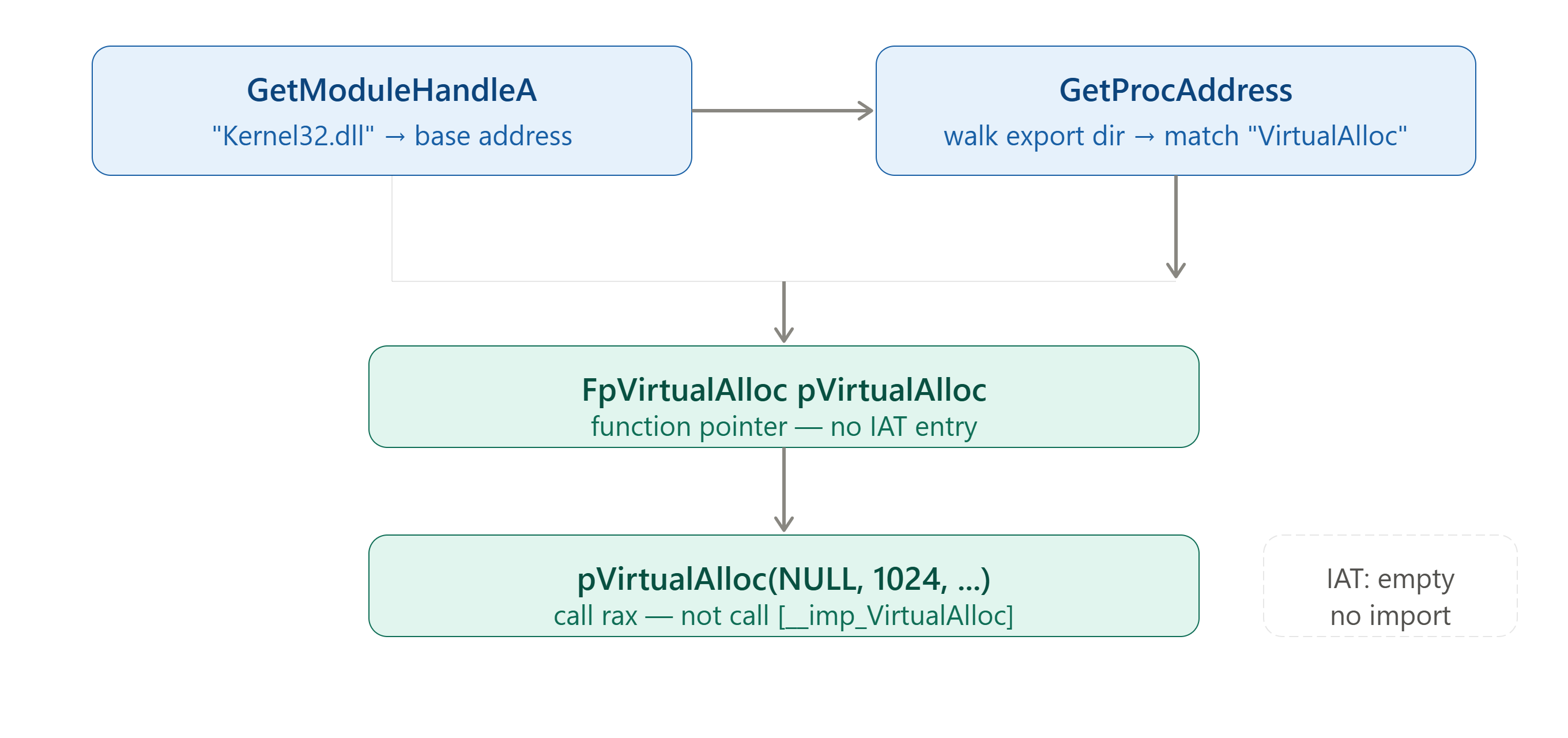
Basec runtime API resolution using GetProcAddress and GetModuleHandleA. Instead of importing VirtualAlloc at compile time — which places it in the PE’s Import Address Table (IAT) and makes the dependency immediately visible to static analysis — the function is looked up at runtime and stored in a local function pointer. The call goes through that pointer rather than through an import thunk.
How it works
Static import (what we avoid)
Compiler sees: VirtualAlloc(…) Linker generates an IAT entry: [kernel32.dll!VirtualAlloc] PE loader fills the IAT at load time with the real VA
The limitation: GetProcAddress string in .rdata — and what the next step is (API hashing)
Dynamic resolution (what we do)
1
2
3
4
5
6
7
8
9
10
11
12
13
14
15
16
17
GetModuleHandleA("Kernel32.dll")
→ returns the base address of kernel32.dll
→ kernel32 is loaded in every Windows process so this always succeeds
→ does NOT increment the DLL's reference count (vs LoadLibraryA which does)

GetProcAddress(hKernel32, "VirtualAlloc")
→ walks kernel32.dll's export directory
→ matches "VirtualAlloc" by name → returns the function's VA
→ identical to what the PE loader does at startup — just done on demand

pVirtualAlloc = (FpVirtualAlloc)result
→ stored in a local function pointer variable

pVirtualAlloc(NULL, 1024, MEM_COMMIT | MEM_RESERVE, PAGE_READWRITE)
→ call goes through a register: call rax (or similar)
→ no IAT entry, no import thunk
→ static analysis of the PE imports list shows nothing
dynamic-res.c
1
2
3
4
5
6
7
8
9
10
11
12
13
14
15
16
17
18
19
20
21
22
23
24
25
26
27
28
29
30
31
32
33
34
35
36
37
38
39
40
41
42
43
44
45
46
47
48
49
#include <Windows.h>
#include <stdio.h>


/*
    Function pointer typedef for VirtualAlloc — mirrors the original WinAPI signature

    lpAddress       -> preferred base address (NULL = let OS choose)
    dwSize          -> number of bytes to allocate
    flAllocationType-> MEM_COMMIT | MEM_RESERVE, etc.
    flProtect       -> page protection (PAGE_READWRITE, PAGE_EXECUTE_READWRITE, etc.)
*/
typedef LPVOID(WINAPI* FpVirtualAlloc)(
    LPVOID  lpAddress,
    SIZE_T  dwSize,
    DWORD   flAllocationType,
    DWORD   flProtect
    );

int main() {

    FpVirtualAlloc  pVirtualAlloc = NULL;
    LPVOID          pBuffer = NULL;


    // GetProcAddress walks the export directory of the module and returns the VA of the named export — identical to how the PE loader resolvesimports, but done at runtime instead of load time
    pVirtualAlloc = (FpVirtualAlloc)GetProcAddress(GetModuleHandleA("Kernel32.dll"), "VirtualAlloc");

    if (!pVirtualAlloc) {
        printf("[!] Failed to resolve VirtualAlloc \n");
        return -1;
    }

    printf("[+] VirtualAlloc resolved at: 0x%p \n", pVirtualAlloc);

    // Call VirtualAlloc through the function pointer
    pBuffer = pVirtualAlloc(NULL, 1024, MEM_COMMIT | MEM_RESERVE, PAGE_READWRITE);

    if (!pBuffer) {
        printf("[!] VirtualAlloc Failed: %d \n", GetLastError());
        return -1;
    }

    printf("[+] Allocated 1024 bytes at: 0x%p \n", pBuffer);

    printf("[#] Press <Enter> To Exit ... \n");
    getchar();
    return 0;
}
This post is licensed under
CC BY 4.0
by the author.